
Links
- Returpack
- Notisum (Swedish law resource)
- Reduce, Reuse, Refill: Other countries (Scroll down for Sweden)
- The Government Offices of Sweden
- Research help from the Law Library of Congress
Sweden
Sweden has had some form of legislated deposit on beverage containers since 1984. The current system was established in 2006, by the "Ordinance (2005:220) on the return system for plastic bottles and metal cans." For the historical deposit laws that existed from 1984 to 2005, click here.
SFS 2005:220 |
|
|---|---|
| Law Summary | Requires a financial incentive to encourage the return and recycling of plastic bottles and aluminum cans |
| Date Implemented | January 1, 2006 |
| Containers Covered | Aluminum cans, plastic bottles |
| Beverages Covered | All ready-to-drink beverages, excluding dairy and juices |
| Refundable Deposits | Amount not specified by legislation |
| Law Text | Swedish Version Google English Translation |
Program Success | 2012 Recovery/Redemption rate: Overall: 85% Metal/can: 85% PET <1l: 73% PT >1l: 92% |
SFS 2006:1273 |
|
| Law Summary | Requires all consumer packaging introduced in Sweden to be picked up by the manufacturer and disposed of in an environmentally responsible manner. Sets recycling target rates. |
| Date Implemented | January 1, 2007 |
| Law Text | Program Success | No Information available |
Details
Requires all beverages sold in plastic bottles or aluminum cans to be covered by a return/recycling system. The system is not government-run; therefore any entity may run a return system for any number of brands, provided the system is approved by the Board of Agriculture.
Key retailers include: COOP/SOK, ICA, NETTO/DS, AXFOOD, LIDL, and Bergendahls.
Deposit values and fees
The law requires a financial incentive to return containers to the system, but does not explicitly require a refundable deposit. It is up to the entity running the system to decide the exact nature and amount of this incentive, with the approval of the Board of Agriculture. For example, Returpack, the primary deposit organization in Sweden, has set the following deposits:a
- Aluminum cans: 1 Swedish Krona (SEK) (marked on label as 1 kr (0.11€))
- PET bottles up to 1L: 1 SEK (marked on label as 1 kr (0.11€))
- PET bottles over 1L: 2 SEK (marked on label as 2 kr (0.22€))
Handling Fees
- Manual Collection:
Metal - 0 SEK
Plastic <1l - 0.2 SEK (0.023 €)
Plastic >1l - 0.2 SEK (0.023 €) - RVM without compaction:
Metal - 0.2 SEK (0.023 €)
Plastic <1l - 0.2 SEK (0.023 €)
Plastic >1l - 0.2 SEK (0.023 €) - RVM with compaction:
Metal - 0.15 SEK (0.017 €)
Plastic <1l - 0.38 SEK (0.043 €)
Plastic >1l - 0.42 SEK (0.048 €)
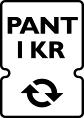 The law also requires containers to be labeled with the refund amount. The marking must be approved by the Board of Agriculture. Returpack's label is shown, as an example, to the right.
Returpack also charges administration fees for plastic bottles and sorting fees for certain containers (steel cans, colored PET bottles, other plastic materials). The deposit is fully refundable, but the fees are paid one-way by the beverage companies to Returpack. Beverage companies and transporters pick up empty containers from stores and restaurants and are subsequently paid a handling fee by Returpack.b
Recycling
Provisions for the recycling of containers covered by the return system law are set out in the 2006 Regulation on producer responsibility for packaging. This law requires all consumer packaging to be picked up by consumers, disposed of in an environmentally responsible manner, and recycled at the following rates (from 2009 onward; prior to 2009, lower overall rates were permitted):c
- All packaging waste: 60% recovery, 55% recycling
- Metal packaging (not beverage packaging): 70% recycling
- Paper packaging: 65% recycling
- Plastic packaging (not beverage packaging): 70% recovery, 30% recycling
- Glass packaging: 70% recycling
- Metal beverage packaging (i.e. metal cans): 90% recycling
- Plastics beverage packaging (i.e. PET bottles): 90% recycling
- Wood packaging: 70% recovery, 15% recycling
- Other packaging (per packaging material): 30% recovery, 15% recycling
According to the regulation (Appendix 3)c, energy recovery by incineration is considered an acceptable form of recycling.
Because beverage containers are already covered under Ordinance 2005:220, most of the provisions of the Regulation on Producer Responsibility do not apply to them. However, beverage manufacturers must adhere to the reporting requirements of the law and must ensure that emissions of harmful substances is minimized when packaging is landfilled or incinerated and impact on the environment is limited when packaging is disposed.d
Footnotes
a. Source: Returpack (In English). "Appendix 3 - Deposit and Fees." http://www.returpack.se/filer/file/Appendix%203%20-%20Deposit%20and%20Fees.pdf Accessed Jun 29, 2011
b. Source: Returpack. (In English) "Importers and Breweries." http://www.returpack.se/ Accessed Jun 29, 2011
c. Source: Sweden Cabinet Office. "Regulation (2006:1273) on producer responsibility for packaging." (Google Translation). http://translate.googleusercontent.com/translate_c?ie=UTF8&rurl=translate.google.de&sl=sv&tl=en&u=http://www.notisum.se/rnp/sls/lag/20061273.htm&usg=ALkJrhiHbEkvVBDgaJbAtuskWm5kY2uKqg# Accessed Jun 29, 2011.
d. Source: Sweden Cabinet Office. "Regulation (2006:1273) on producer responsibility for packaging." (Google Translation). Section 3. http://translate.googleusercontent.com/translate_c?ie=UTF8&rurl=translate.google.de&sl=sv&tl=en&u=http://www.notisum.se/rnp/sls/lag/20061273.htm&usg=ALkJrhiHbEkvVBDgaJbAtuskWm5kY2uKqg# Accessed Jun 29, 2011.
